
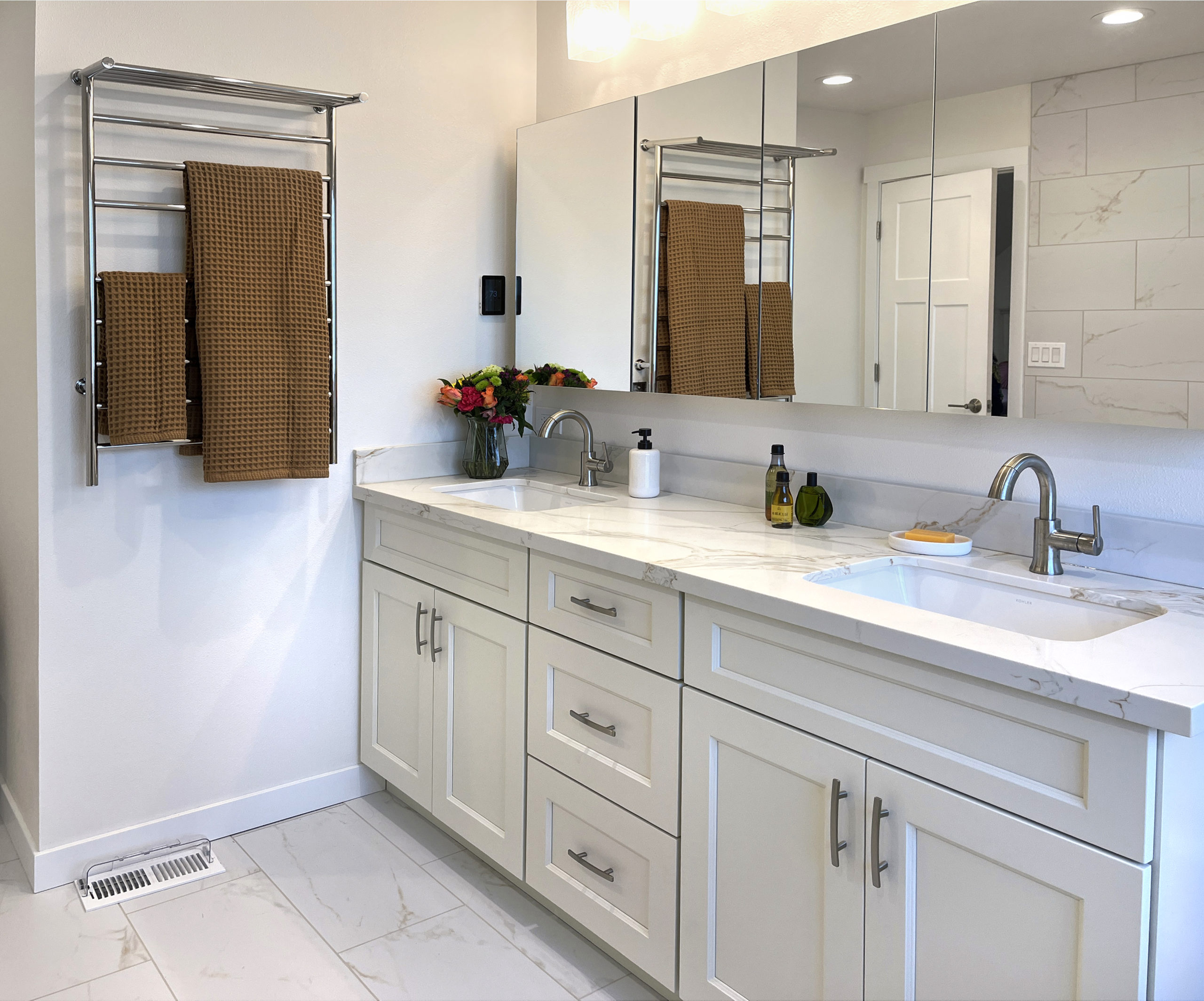
Here’s something most homeowners don’t find out until it’s too late: most bathroom remodels aren’t truly waterproof. No matter how carefully you tile over it, some bathrooms are never designed to handle the moisture levels of a daily-use shower. Over time, water finds its way through grout joints, behind tile, and into that drywall. And once moisture gets into standard drywall in a shower, the damage it causes is invisible until it’s already significant.
In the Pacific Northwest, this is a common occurrence we see when working with homeowners. We see it a lot with bathrooms that were remodeled without true waterproofing built into the system.
Here’s what a truly waterproof bathroom remodel looks like, and why it matters for your home.
Table of Contents:
- The Problem With Most Bathroom Remodels
- What a Fully Waterproof Bathroom Actually Does for You
- What This Looks Like in a Corvus Remodel
- Is This Right for Your Bathroom?
The Problem With Most Bathroom Remodels
A standard bathroom remodel looks like this: demo the old tile, install fiber-cement board or standard moisture-resistant drywall as a substrate, tile over it, grout, seal. It looks waterproof. The problem is that the substrate underneath — the layer between your tile and the wall framing — isn’t actually waterproof. It’s water-resistant, which is a meaningful difference.
Water-resistant means it tolerates moisture reasonably well for a while. Waterproof means moisture can’t penetrate it, period.
Traditional, cementitious grout is porous. Grout joints are the seams where tiles meet, and those seams are where water enters — every single shower. Since showers run daily, that constant moisture finding its way through grout is exactly the condition that leads to mold growth, rot, and structural damage behind the walls that you can’t see until it’s already a problem.
What a Fully Waterproof Bathroom Actually Does for You
When your bathroom is built with a genuinely waterproof system behind the tile, a few things change:
Your bathroom lasts significantly longer. The tile and grout you can see are one thing. The system behind them is what determines whether the bathroom holds up for 10 years or 30. A waterproof build protects the investment you’re making in the remodel itself — not just from the day it’s finished, but for the life of the home.
Mold doesn’t have a place to grow. Mold needs two things: organic material and moisture. Standard drywall is organic material. Moisture gets through grout. That combination, inside a wall cavity where you can’t see it, is where mold problems start. A fully waterproof system eliminates the moisture variable entirely — there’s nowhere for water to accumulate behind the tile.
You don’t have to redo it in 8 years. One of the most common calls a remodeling contractor gets is from homeowners whose bathroom was renovated less than a decade ago and is already failing — grout cracking, tile loosening, soft spots in the wall. That’s almost always a waterproofing failure. Building it right the first time means you’re not having this conversation again anytime soon.
What This Looks Like in a Corvus Remodel
Corvus Construction is a certified WEDI installer (also Hydro-Blok and Schluter). We’re one of the only remodelers in Snohomish County with this certification. What that means for your bathroom is that when we build a shower or wet area, the entire system behind the tile is designed to prevent moisture from ever reaching the wall framing.
You won’t see this difference when the bathroom is finished — it’s behind the tile. But you’ll feel it every time you’re in that bathroom for the next 20 years. No soft spots. No grout that keeps failing. No mystery water stains appearing on the other side of the wall.
For homeowners in Lake Stevens, Marysville, Everett, and throughout Snohomish County who are investing in a bathroom remodel, it’s the kind of build quality that makes the difference between a remodel that holds up and one that becomes a recurring problem.
Is This Right for Your Bathroom?
If you’re planning a bathroom remodel and you care about it lasting — and not having to deal with mold, failing tile, or moisture damage behind your walls — a fully waterproof build is worth asking about.
Not every bathroom remodel requires it to the same degree. A powder room with no shower is a different situation than a primary bathroom with a custom tile shower that runs twice a day. But for any wet area — any shower, any tub surround, any space where water is regularly present — a waterproof system is the right foundation.
Corvus Construction works with homeowners across Snohomish County to build bathrooms that are as solid behind the tile as they are beautiful in front of it. If you’re planning a remodel and want to talk through what a fully waterproof build would look like for your specific bathroom, we’d love to have that conversation.
Contact Corvus Construction for a free bathroom remodel consultation →